



How to choose the best 3D scanner for your 3D printer
Choosing the right 3D scanner for a 3D printer can be challenging, as there are many different models and technologies available. Depending on the specific requirements of the project, various scanners may be suitable. Therefore, the decision for a 3D scanner for 3D printing should be based on several factors, such as the scanning technology, the required scan quality, the device’s flexibility, and the intended application area.
Selecting the right scanning technology
When selecting the right scanning technology for a 3D scanner for a 3D printer, several factors play a key role, especially the required level of accuracy and scanning speed. Two of the most commonly used technologies are laser triangulation and structured light projection, each offering distinct advantages and areas of application.
Laser triangulation
In laser triangulation, a laser beam is projected onto the object, and a sensor captures the reflection to calculate its geometry. This technology provides high accuracy, making it ideal for precise components and prototypes. It performs particularly well with complex geometries, which makes it a preferred choice for technical and engineering applications. Modern handheld 3D scanners for 3D printing that project multiple laser lines simultaneously can capture objects much faster and more efficiently than systems using only a single laser line.
Structured light projection
Structured light projection uses light patterns that are projected onto the object. Cameras then record the distortions to calculate the object’s shape. This method produces highly detailed scans, making it perfect for capturing organic shapes and design objects. It offers excellent resolution and is therefore ideal for scanning fine surface structures in 3D printing. In addition, it provides a well-balanced compromise between accuracy and speed.
Size and resolution requirements
Depending on the object’s size and surface characteristics, different 3D scanners are better suited for the task, as the scanning area varies from model to model. Handheld 3D scanners for 3D printing can be moved manually around the object, offering great flexibility with minimal size limitations. Their mobility also makes it possible to capture hard-to-reach areas with ease.
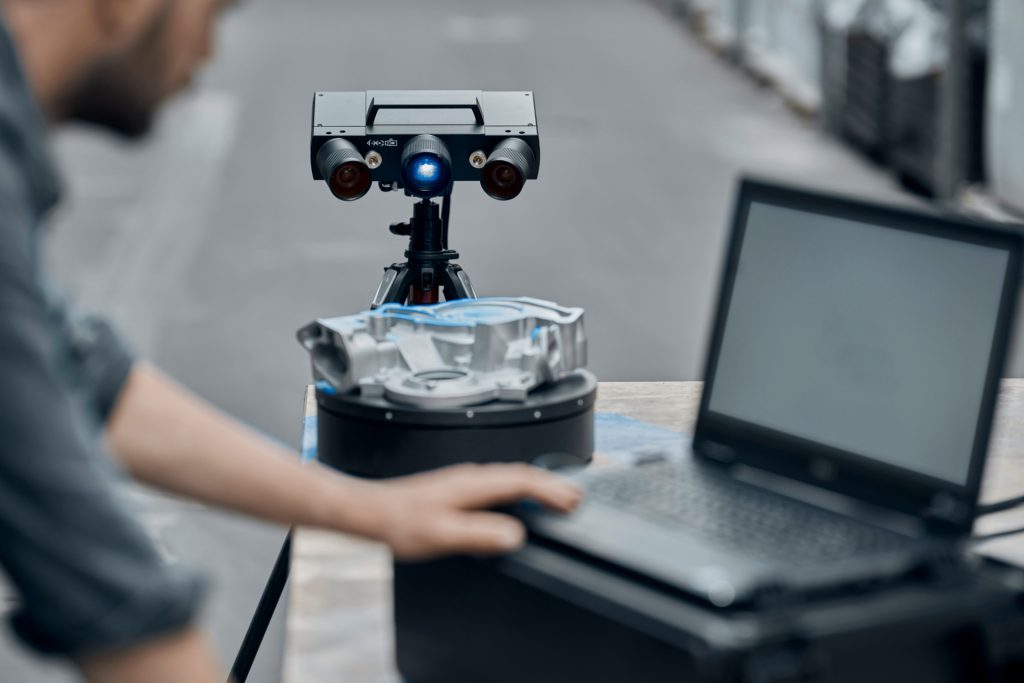
For 3D scanners using structured light projection, a turntable that rotates on multiple axes can be used to scan the object from all sides. Achieving a complete, gap-free digital capture of all relevant geometries is essential in reverse engineering and quality control. This ensures that there are no holes in the 3D model that would otherwise require software-based repair during post-processing.
Structured light scanners are well suited for small to large objects that require high accuracy. Additional information can be found in the guides on 3D scanners for small objects and 3D scanners for large objects, helping you choose the right 3D object scanner for 3D printing based on your needs.
Accuracy and detail capture
The resolution and accuracy of a 3D scanner are crucial for reverse engineering and directly affect the quality of the printed result. A resolution that is too low or even too high can negatively influence the final outcome. In quality control, both resolution and accuracy impact the precision of deviation analyses and inspection reports.
Resolution refers to the distance between the individual measurement points captured on the surface of the object. If surface details are smaller than the scanner’s resolution, they will not be recorded, which can lead to inaccuracies in the resulting 3D model.
Accuracy, on the other hand, depends not only on the distance between the scanner and the object but also on many additional factors. These include sensor resolution, the quality of optical components, the light source, image quality, calibration, and the algorithmic processing of the data. Laser scanners and structured light scanners with high accuracy are particularly suitable for professional applications and complement 3D printers with high resolution perfectly, creating a powerful synergy between 3D scanning and 3D printing.
Flexibility and portability
Portable 3D scanners offer a high degree of flexibility, as they can be used in a wide range of locations. In particular, handheld 3D scanners for 3D printers are ideal for scanning hard-to-reach areas or stationary objects, since they can be manually moved around the object.
When choosing a 3D scanner for 3D printing, it is also important to consider compatibility with different materials and surfaces. Various materials can present unique scanning challenges and require specific technologies to ensure optimal results. Selecting an object scanner for 3D printing that performs reliably across multiple surface types helps maintain accuracy and efficiency in the entire workflow.
Application areas for 3D scanning and 3D printing
Different industries and applications benefit from specialized 3D scanners for 3D printers, depending on whether the goal is to scan small objects, large components, or perform extremely precise measurements. The choice of scanner should always reflect the specific task and the requirements of the 3D printing process.
Industry and medical technology
These sectors primarily use laser scanners and structured light scanners, as they deliver highly accurate data across a range of component sizes and materials.
Indoor and outdoor applications
Handheld 3D scanners for 3D printers and portable scanners with lightweight tripods are ideal for flexible use both indoors and outdoors. They are easy to transport and can capture large objects with precision.
Reverse engineering
Laser scanners and structured light scanners are particularly well suited for reverse engineering, as they provide the high-precision data needed for part reconstruction and analysis.
Replication and repair
Portable 3D scanners with high accuracy are perfect for quickly scanning and reproducing damaged or complex parts.
Manufacturing custom components
Both laser and structured light scanners are valuable for producing customized data required in the manufacturing of tailored components.
Rapid prototyping
For fast prototyping, handheld 3D scanners for 3D printing or portable high-resolution scanners offer the flexibility needed to capture and modify 3D models efficiently.
Quality assurance
Stationary 3D scanners, portable scanners with tripods, and laser scanners provide the level of precision necessary for inspecting and ensuring the quality of components and finished products.
ZEISS 3D scanners for 3D printers
As a leading manufacturer in precision metrology, ZEISS offers advanced 3D scanners for 3D printers that are specifically optimized for 3D printing applications. These scanners enable precise data capture and digital scanning of objects, helping to enhance and accelerate the entire process of 3D scanning and 3D printing.
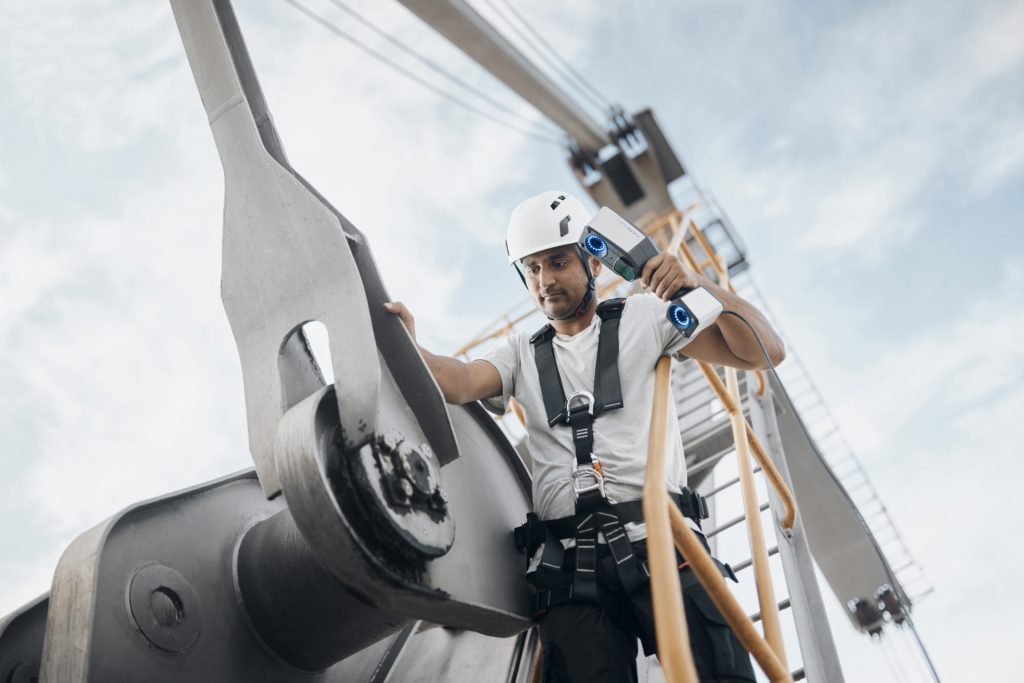
ZEISS T-SCAN hawk 2
- Scanning technology: Handheld laser scanner
- Size of object: Medium to large objects (up to several meters)
- Resolution & accuracy: High resolution and exceptional accuracy
- Flexibility: Highly flexible and fully portable
- Applications: Industry, maintenance, repair, mobile measurements, and reverse engineering
GOM Scan 1

- Scanning technology: Structured light scanner
- Size of object: Small to medium-sized objects
- Resolution & accuracy: Extremely high level of detail and accuracy
- Flexibility: Portable or stationary use with tripod; can also be semi-automated with ZEISS ScanPort
- Applications: Product development, quality control, design, and 3D printing preparation
ATOS Q
- Scanning technology: Structured light scanner
- Size of object: Small to medium-sized objects
- Resolution & accuracy: Highest precision and accuracy
- Flexibility: Portable or stationary with tripod; also suitable for semi-automated and fully automated measurement systems
- Applications: Additively manufactured parts, plastic and injection-molded components, and applications in sand casting, die casting, and investment casting, as well as in stamping, bending, drawing, pressing, and forming processes
How 3D scanning and 3D printing work together
- Reverse engineering & dimensional accuracy: With 3D scanners, existing objects can be precisely digitized. This not only simplifies reverse engineering but also enables exact reproduction using a 3D printer. As a result, new models can be developed and implemented more quickly and with greater accuracy.
- Creating digital copies for archiving or modification: 3D scanners make it possible to generate exact digital copies of physical objects, which can be used for archiving or for future modifications in digital formats.
- Streamlining the workflow through direct CAD integration: Scan data can be transferred directly into CAD software, eliminating the need for manual modeling and making the entire 3D scanning and 3D printing process significantly more efficient.
- Reducing errors and post-processing effort in printing: By precisely digitizing objects, potential error sources are minimized, reducing the need for corrections and post-processing during 3D printing.