


What is a 3D scanner?
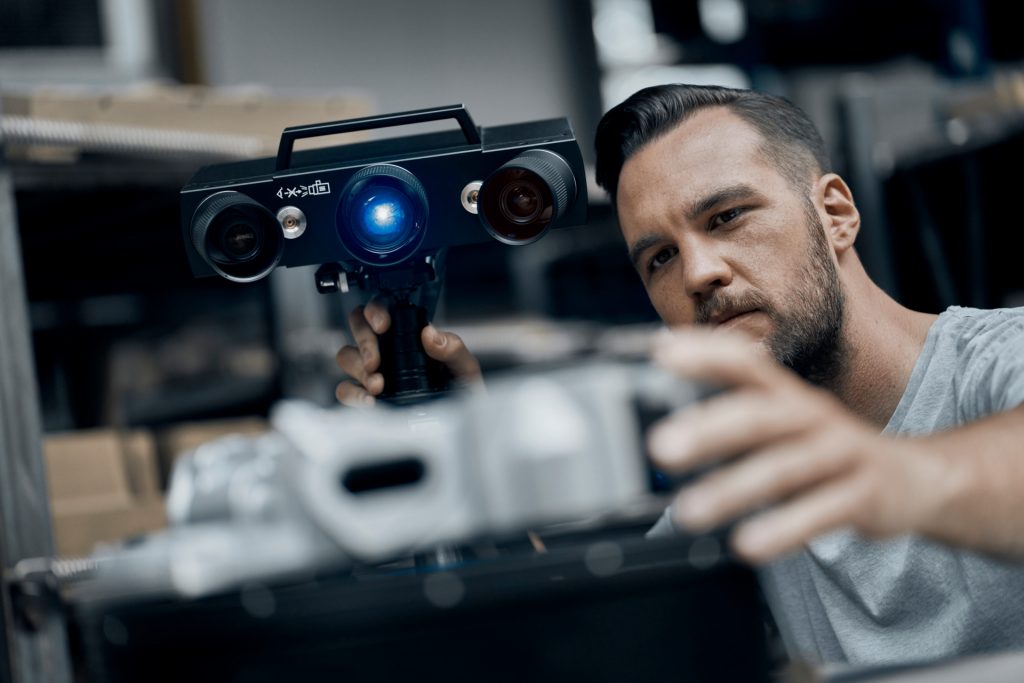
A 3D scanner is an optical, non-contact measurement system that captures the geometry of real-world objects with high precision and converts it into digital models. Instead of taking measurements manually, the technology uses light or laser to scan the surface of an object and generate a highly accurate digital representation. This process creates a point cloud, which is then transformed into a precise 3D model.
How a 3D scanner works is versatile: In industrial environments, it is used for quality control, product development, and manufacturing. In research and design, it provides accurate data for analysis, modeling, and engineering tasks.
What types of 3D scanners exist?
There are several types of 3D scanners, each based on different technologies and suited for different applications. In industrial environments, scanning methods that deliver the highest accuracy and reliable results are preferred. At ZEISS, the focus is primarily on laser scanners and structured light scanners, as these technologies are especially well suited for capturing surfaces and geometries with exceptional precision.
Laser scanners

Laser scanners are a type of 3D scanner that operate according to a clearly defined working principle. A laser beam is projected onto the surface of the object to be measured. The reflected light is captured by a camera or sensor, allowing the distance to be calculated using either triangulation or time-of-flight methods. In this way, the object is scanned point by point or line by line until a detailed point cloud is created. The way a 3D laser scanner works makes it possible to capture even large geometries with high accuracy, producing a precise digital representation of the original object.
Laser scanners are ideal for measuring large components in industries such as plant engineering, automotive manufacturing, and heavy machinery. They can digitize vehicle frames or aircraft fuselages just as accurately as pipelines, machine foundations, or large castings. They are also widely used in aerospace, wind energy, shipbuilding, and locomotive construction. A prime example of a modern system is the handheld 3D scanner ZEISS T-SCAN hawk 2, designed for mobile and highly accurate scanning applications.
Key advantages of T-SCAN hawk 2:
- Mobile measurement without complex fixtures
- Precise capture of complex geometries, even on shiny or dark surfaces
- High scanning speed for efficient workflows
- Compact, portable design for flexible use directly at the object
Structured light scanners
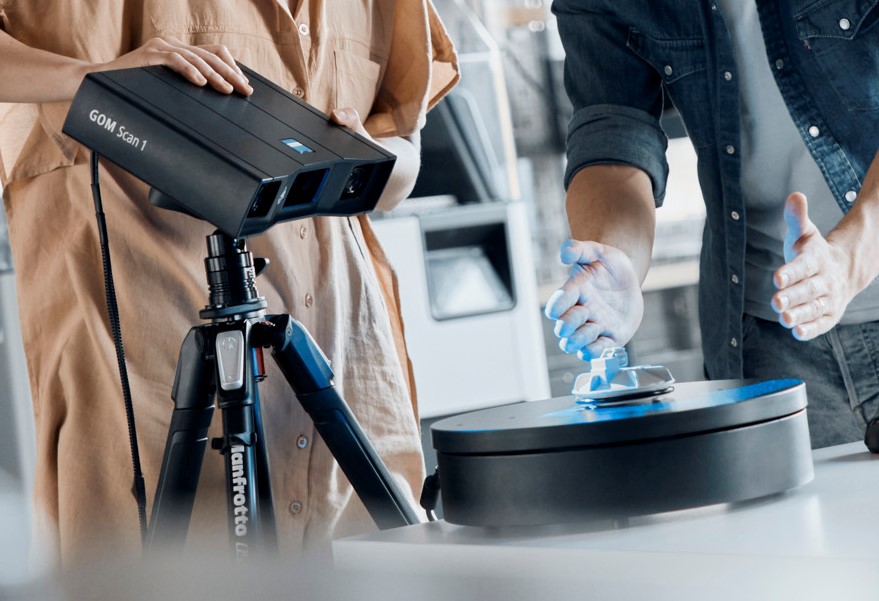
Structured light scanners use an optical measurement principle in which a projector casts a regular pattern, typically a series of stripes, onto the surface of an object. This light pattern is distorted by the object’s geometry and recorded by two cameras from different angles. Using triangulation, the system calculates highly accurate 3D coordinates. Unlike laser scanners, structured light scanners capture entire surface areas at once, enabling the rapid creation of a dense, high-resolution point cloud.
This scanning principle offers exceptionally fast and precise acquisition of complex surfaces, which is why it is widely used in quality control, product development, and reverse engineering. Typical applications range from plastic, sheet metal, and cast parts to precision components in medical technology and electronics manufacturing. Structured light scanners are also established in aerospace, for turbine blades, injection nozzles, and more, as well as in automotive engineering for injection-molded parts or housing elements.
With ATOS Q and GOM Scan 1, ZEISS offers two powerful systems designed for flexible use in both industry and research.
Key advantages of ATOS Q:
- Very high resolution for delicate details and complex geometries
- Flexible adaptation through interchangeable measuring volumes for different object sizes
- Suitable for both manual and automated workflows
Provides complete 3D data for CAD comparisons, inspection reports, and analyses - Designed to operate reliably even in harsh industrial environments
Key advantages of GOM Scan 1:
- Ideal for measuring small to medium-sized objects, typically from a few millimeters up to around 40 centimeters, thanks to fine measuring fields with high resolution
- Precise scans using structured light technology, even on challenging surfaces
- Easy to operate for smooth day-to-day workflows
- Compact design for use in confined workspaces
How does a 3D scanner work?
How a 3D scanner works can be divided into three main phases. First comes the scanning step, in which the surface of an object is captured using light or laser beams. In the next phase, the acquired data is processed and converted into a structured point cloud. In the third phase, this point cloud is transformed into a complete digital 3D model that can be used for applications such as CAD, quality control, or reverse engineering.
Regardless of the underlying technology, the basic function of a 3D scanner remains the same: a real-world object is captured and converted into a digital model. In the following sections, you will learn step by step how a 3D scanner works and how 3D scanning works in modern industrial applications.
Scanning: Capturing the surface with light or laser
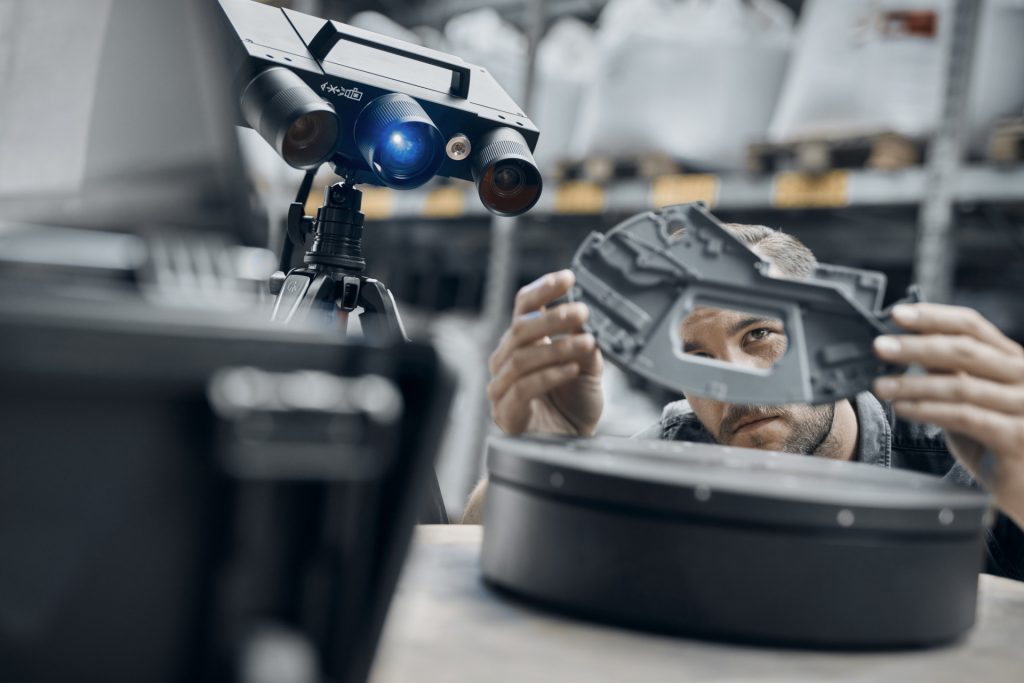
The first step in 3D scanning is capturing the surface of the object. In structured light scanning, a regular light pattern is projected onto the object, and the resulting distortions provide information about its geometry. In laser scanning, on the other hand, a laser beam scans the surface point by point while one or more cameras record the reflected light.
Both methods generate a high-resolution point cloud consisting of millions of 3D coordinates. This point cloud represents the object’s surface structure in precise detail and enables the non-contact and highly accurate capture of delicate or complex geometries.
Data processing: From points to digital models
After the point cloud has been captured, the 3D scanner automatically transfers the data to 3D processing software such as ZEISS INSPECT. There, noise, outliers, and surfaces recorded at unfavorable angles are removed — areas where a high gradient between the sensor and the surface prevents usable measurements. The software also eliminates unwanted points, such as data lying below a defined trim plane, ensuring a clean and reliable basis for further processing.
Next, the individual scans are aligned with one another to achieve an exact registration of all datasets. Multiple viewpoints can then be merged into a complete point cloud that accurately represents the entire object.
In the following step, the point cloud is converted into a triangle-based polygon mesh. This mesh is refined: holes are closed, gaps are repaired, and edges are smoothed to create a clean geometric foundation. Modern software solutions automatically detect geometries and correct measurement artifacts, such as warping or small holes, without altering the object’s complex structures. The result is a robust digital model ideal for analysis, CAD comparison, and further engineering workflows.
Modeling: Creating 3D models for CAD, analysis & more
From the generated polygon meshes, surface-based or CAD-ready models are created that can be used directly in design and development processes. With ZEISS REVERSE ENGINEERING, the data captured by the 3D scanner can be converted into CAD-compatible surface models and imported into common CAD systems. This way, the modeling step forms the foundation for digital product development, design modifications, and the optimization of existing components.
The data can be transferred directly from ZEISS INSPECT and prepared for subsequent processing steps. As a result, it is immediately available for simulations, quality inspections, or additive manufacturing. The refined models are also ideal for reproducing, documenting, or further developing components, as they represent the original geometry with full detail and high accuracy.
From point cloud to product: ZEISS software solutions
Software plays a central role, so that the data captured by a 3D scanner provides real value in practical applications. Only with powerful processing tools can point clouds be transformed into meaningful digital models that can be used for analysis, quality inspections, or reverse engineering into CAD systems.
ZEISS offers specialized software solutions that support users both in evaluating scan data and in creating CAD-ready models, enabling reliable workflows from initial scanning to final digital representation.
Analyzing scan data with ZEISS INSPECT
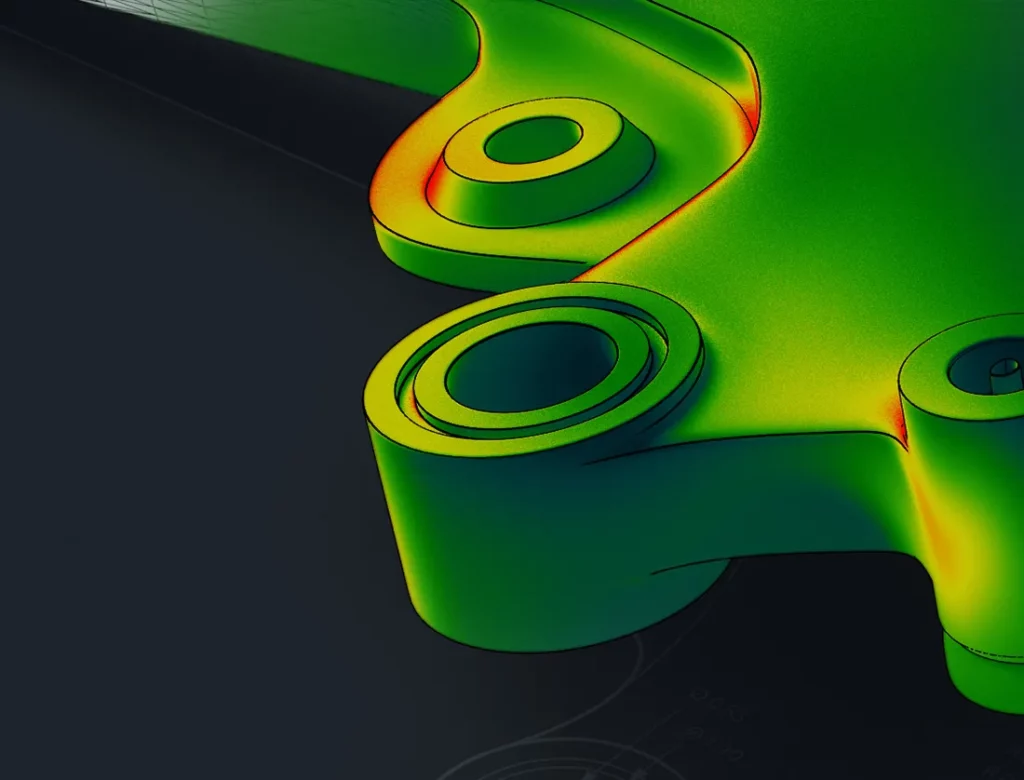
ZEISS INSPECT is a powerful software solution for analyzing and verifying the quality of 3D scans. It enables visual evaluation of tolerances as well as form and positional deviations, helping users to reliably detect even the smallest differences. Automated inspection reports ensure that results are clearly documented and can be shared efficiently.
With its advanced analysis tools and automated inspection workflows, ZEISS INSPECT is ideally suited for series production and quality assurance. The 3D software is compatible with all optical ZEISS scanners, providing a fully integrated solution for evaluating scan data quickly, accurately, and consistently.
ZEISS REVERSE ENGINEERING
With ZEISS REVERSE ENGINEERING, precise CAD-ready formats can be generated from polygon meshes. The 3D scanning software enables accurate surface reconstruction, allowing even complex geometries to be faithfully converted into usable design data.
This makes the solution ideal for reverse engineering tasks, design optimization, and manufacturing processes. Users gain a reliable foundation for further developing existing components, and the resulting models can be imported directly into all common CAD systems.